


At Tidewater Financial, we bring over 50 years of experience to the fixed-income market, specializing in Mello-Roos bonds—a potentially attractive investment option. Explore the tax-efficient properties of these bonds and how they can enhance your investment portfolio through steady returns and significant tax advantages.
The Origin of Mello-Roos Bonds
Mello-Roos bonds were established in California in 1982, named after their legislative authors, Henry Mello and Mike Roos. These bonds were created to fund public projects in response to the limitations imposed by Proposition 13 on local property tax increases. This historical context adds a layer of understanding to the importance and utility of these bonds in public financing.
What Are Mello-Roos Bonds?
Mello-Roos bonds are issued by special tax districts in California, established under the Community Facilities Act of 1982. These bonds fund essential public improvements and services such as schools, parks, and infrastructure. The financing for these projects is secured through a special tax levied on property owners within these districts, ensuring a steady revenue stream for bond repayment.
Why Invest in Mello-Roos Bonds?
- Tax Efficient Revenue Stream: The special tax mechanism may provide a reliable source of revenue for bond repayment, making Mello-Roos bonds potentially a stable investment.
- Long-Term Investment: With terms typically ranging from 10 to 40 years, these bonds are designed to offer long-term financial predictability.
- Community Impact: Investments in Mello-Roos bonds directly support community development projects, enhancing property values and local economies.
Tax Benefits and Taxable Equivalent Yields
Tax Advantages of Mello-Roos Bonds
Mello-Roos bonds are a form of municipal bond, and the interest income generated from these bonds is typically exempt from federal and state income taxes if you reside in the state where the bonds are issued. This makes Mello-Roos bonds particularly attractive for investors looking to reduce their taxable income.
Understanding Taxable Equivalent Yields
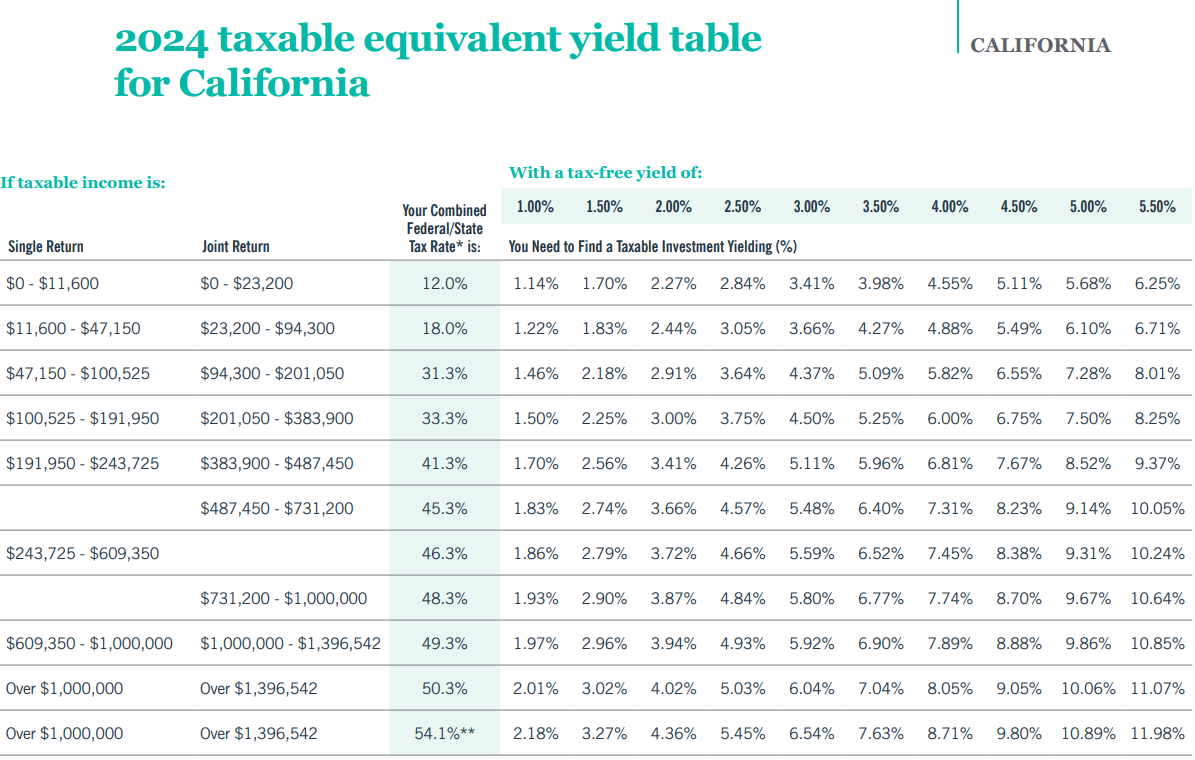
The 2024 taxable equivalent yield table for California helps investors understand the equivalent taxable yield needed to match various tax-free yields, based on their taxable income and combined federal/state tax rate. The table is divided into different income brackets for single and joint returns, with corresponding tax rates ranging from 12% to 54.1%. For each tax-free yield percentage, the table lists the taxable yield that an investor would need to earn to achieve the same after-tax return. For instance, a taxpayer in the 31.3% tax bracket with a tax-free yield of 2% would need a taxable investment yielding 2.91% to equate the same net return. This table is particularly useful for evaluating the attractiveness of tax-free municipal bonds compared to taxable investments.
Why This Matters
For investors, especially those in higher tax brackets, the taxable equivalent yield is a crucial metric. It shows how much more yield a taxable bond needs to offer to be equivalent to a tax-free bond, after accounting for tax implications. The higher your tax rate, the more beneficial the tax-free bond becomes.
Why Choose Tidewater Financial?
At Tidewater Financial, we not only offer over 50 years of cumulative experience in the fixed-income market, but we also operate in a niche to benefit many of our clients: Mello-Roos bonds. Here’s why partnering with us can be a pivotal decision for your financial strategy:
Direct Impact on Community Enhancement
Expert Guidance Through Complexity
Commitment to Client-Centric Service
Conclusion
Investing in Mello-Roos bonds through Tidewater Financial is designed to offer stability and tax efficiency making them an attractive choice for tax-conscious investors. These investments not only yield considerably tax-efficient returns but also contribute to the development and enhancement of community infrastructure.