


Exploring the 1915 Act Bond: A Unique Investment Opportunity
Welcome to Tidewater Financial! With over 50 years of experience in the fixed-income market, we are excited to tell you about the 1915 Act Bond. This bond is named after the Improvement Bond Act of 1915 and is a great investment option if you're looking for potential stable and tax-advantaged returns. Let's take a closer look at what makes the 1915 Act Bond special and how it can benefit you.
The Origin of the 1915 Act Bond
The Improvement Bond Act of 1915 was created in California to help cities and towns pay for important public projects. These projects include building and fixing roads, water systems, and sewer systems. The Act lets local governments issue bonds to raise money for these projects, with repayment coming from special assessments on the properties that benefit from the improvements. This way, the costs are paid by those who benefit the most, not by all taxpayers.
What is the 1915 Act Bond?
The 1915 Act Bond is a type of municipal bond issued by local governments in California. These bonds are backed by special assessments on property owners in specific areas. Property owners agree to pay these assessments over 20 to 40 years to cover the principal and interest on the bonds. This creates a secure income stream for bondholders, as the assessments are a lien on the properties, similar to property taxes.
Why Invest in 1915 Act Bonds?
Potential of Security: The bonds are backed by assessments that are liens on the properties, providing a prospect of the possibility of a high level of security. The assessments are collected along with property taxes, with a steady revenue stream.
Tax Benefits: Interest income from 1915 Act Bonds is usually exempt from federal and state income taxes. This tax-exempt status can increase the after-tax yield for investors, making these bonds potentially attractive to those in higher tax brackets.
Diverse Applications: The proceeds from these bonds finance a wide range of public improvements, contributing to the overall enhancement of community infrastructure. This diversity can provide investors with a sense of contributing to community development while earning returns.
Understanding the Tax-Free Distribution Rate Chart for the 1915 Act Bond
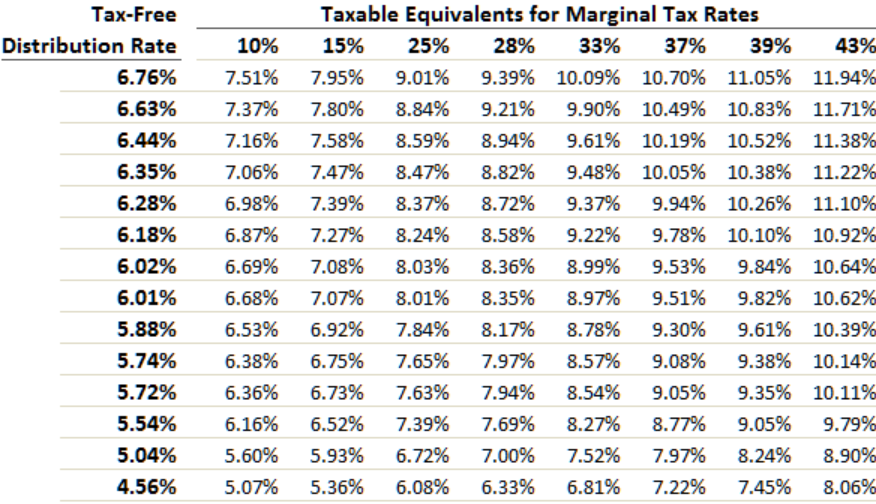
This chart helps you see how the tax-free income from the 1915 Act Bond compares to taxable income, based on your marginal tax rate. Let’s break it down step-by-step:
Tax-Free Distribution Rate
- This is the rate of return you get from the bond without having to pay federal income tax.
- The leftmost column shows different tax-free distribution rates, ranging from 4.56% to 6.76%.
Taxable Equivalents for Marginal Tax Rates
- The columns to the right show the equivalent taxable rate you would need to earn the same amount of money after taxes.
- These columns are labeled with different marginal tax rates: 10%, 15%, 25%, 28%, 33%, 37%, 39%, and 43%.
Example:
If the 1915 Act Bond offers a tax-free distribution rate of 6.44% and your marginal tax rate is 33%, then:
- Look at the row for 6.44% in the leftmost column.
- Move across to the column under 33%.
- The taxable equivalent is 9.61%.
This means you would need a taxable investment to return 9.61% to equal the 6.44% tax-free return from the 1915 Act Bond if you are in the 33% tax bracket.
Benefits of the 1915 Act Bond
Tax Savings: Since the interest income from these bonds is tax-free, they are potentially more beneficial for investors in the higher tax brackets. The higher your tax rate, the more potentially advantageous the bond becomes.
Higher Effective Yield: The tax-free distribution rate can be more valuable than taxable returns, as shown by the higher taxable equivalent rates.
Potential Stability: These bonds offer potentially stable returns while providing the prospect of tax advantages.
Why It Matters
Investing in 1915 Act Bonds is important because it supports crucial community projects while offering investors a potentially stable and tax-advantaged income stream. These bonds provide local governments with the funds needed to improve public amenities without placing a burden on all taxpayers. For investors, the bonds offer a blend of potential security, potentially steady income, and tax benefits, making them a valuable part of a diversified investment portfolio.
Why Choose Tidewater Financial?
Choosing Tidewater Financial to invest in 1915 Act Bonds ensures you are with experts who deeply understand the fixed-income market. Here’s why Tidewater Financial stands out:
Expertise and Experience
With over 50 years of experience in the fixed-income market, Tidewater Financial has the knowledge and expertise to guide you through the complexities of investing in tax-free bonds. Our team is well-versed in identifying the best financial opportunities.
Comprehensive Solutions
We offer a range of investment products and services tailored to your financial goals. Whether you seek wealth accumulation, preservation, or diversification, our comprehensive solutions cater to diverse fixed-income needs.
Client-Centric Approach
At Tidewater Financial, our clients come first. We take the time to understand your financial objectives and create personalized strategies that align with your goals. Our commitment to exceptional service ensures you receive the support and guidance you need every step of the way.
The 1915 Act Bond offers a unique investment opportunity, merging the potential of stability of municipal bonds with the significant advantage of tax-exempt income. These bonds not only provide potentially attractive financial returns but also play a vital role in funding essential infrastructure projects and enhancing community development. For investors looking to diversify their portfolios with a potentially stable and tax-advantaged option, the 1915 Act Bond is a compelling choice.